
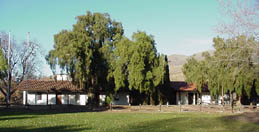
On October 4, 1821 a land grant of 4,394 acres was
issued by Pablo
Vincente de Sola, the last Spanish governor of California, to
Josè Higuera.
Higuera named his land, Rancho Los Tularcitos ("place of the
little
tules").
Early title transfers however, list the name as Rancho San
Ignatio. The rancho stretched from the confluence of
Calera and Pennitencia
creeks in the
northwest to a large live oak tree that marked its southeastern
corner (near present day intersection of Abel St. and Calaveras
Blvd.).
South of
Rancho Los Tularcitos was the land of Pueblo de San José.
The
land grant was
renewed by Mexican Governor Juan B. Alvarado on February 18,
1839. When
the United
States acquired California as part of the Mexican Cession, an
application was filed
with the federal government to a patent and this was issued on
July 8,
1870.
In 1828, Higuera built an adobe house near Arroyo Calera and a
few
years later built
another nearly 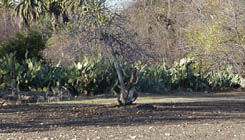 200 feet south along the
creek. It is most
likely the labor for these
constructions was provided by the local Muwekma Ohlone Indians
living
near Mission
San José. A few hundred feet to the southeast stood an
ancient
temescal or sweat
house (sauna) used by the local tribes in ceremonies. Around the
rancho's central
compound, prickly pear cactus was planted to form a hedge. Part
of this
original
hedge may be seen today by looking east from the adobe. The
pepper,
fig, and olive
trees surrounding the present park are historic, believed to
have been
planted by
Josè Higuera in the 1830s.
200 feet south along the
creek. It is most
likely the labor for these
constructions was provided by the local Muwekma Ohlone Indians
living
near Mission
San José. A few hundred feet to the southeast stood an
ancient
temescal or sweat
house (sauna) used by the local tribes in ceremonies. Around the
rancho's central
compound, prickly pear cactus was planted to form a hedge. Part
of this
original
hedge may be seen today by looking east from the adobe. The
pepper,
fig, and olive
trees surrounding the present park are historic, believed to
have been
planted by
Josè Higuera in the 1830s.
During the time of the Mexican War, the adobe was the stopping
place
for a detachment
led by 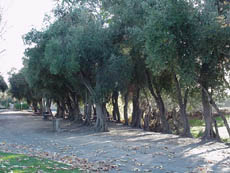 Francisco
Sánchez. At that time, it was known as the hacienda of
Don
José Higuera.
Sanchéz had six American soldiers with him, one was
Lieutenant
Washington A.
Bartlett, acting alcalde of San Francisco (It was Barlett
who renamed the village known as Yerba Buena to San Francisco).
They had been captured by
Sanchéz
while looking for food south of San Francisco near Sixteen Mile
House.
After enjoying
the hospitality of Don José for two days the detachment
moved on
to the south.
Francisco
Sánchez. At that time, it was known as the hacienda of
Don
José Higuera.
Sanchéz had six American soldiers with him, one was
Lieutenant
Washington A.
Bartlett, acting alcalde of San Francisco (It was Barlett
who renamed the village known as Yerba Buena to San Francisco).
They had been captured by
Sanchéz
while looking for food south of San Francisco near Sixteen Mile
House.
After enjoying
the hospitality of Don José for two days the detachment
moved on
to the south.
Don José was host to merrymaking of a more peaceful
nature on
other occasions.
One of the most memorable was the marriage of his beautiful
granddaughter, Margarita
to Nicolás Chavarria. It is said the fiesta continued day
and
night for three
days and was attended by hundreds of well-wishers.
Margarita was the daughter of Valentin Higuera. He sold his
portion of
the Rancho
lands to Clemente Columbet for the princely sum of $3,000.
Columbet had
operated
a hotel in San Jose in 1849. He added a second story to the
adobe and
divided it
into bedrooms. He turned the large single room downstairs into a
reception room.
To attract customers to his countryside "resort" he ran a
coachline to
connect with central Milpitas, then nearly two miles distant.
After a
short time
it became obvious that his country hotel would not earn the
profits he
had hoped
for, so he closed it.
When his business failed, Columbet sold his interest in the
property back to Valentin Higuera who subsequently sold it to
Henry Curtner, a native
of Vermont
who had come overland to settle in Milpitas. Curtner built a
fine house
on the site
of the Indian sauna. He ran cattle and farmed the land. The
adobe of
Don José
became a bunkhouse for workers on the Curtner ranch. In time,
the
second story added
by Clemente Columbet in the 1860s, deteriorated and in the 1950s
was
removed.
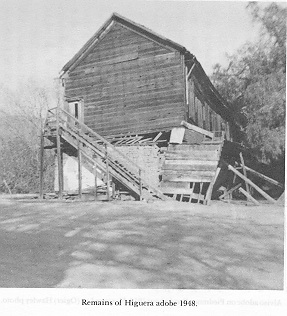
The building you see today is a shell built by Marion Weller,
Curtner's
granddaughter,
in the early 1960s to preserve and protect the ruins of the old
adobe.
In the 1970s
Mrs. Weller gave the adobe, the nearby wooden building known as
the "Casino" and
the adjoining acreage to the city of Milpitas. Shortly
thereafter the
city tore down the brick wall and added a kitchen and indoor
restrooms
to the south end of the adobe. For
over a decade the building was rented for Scout meetings,
birthday
celebration, and
wedding receptions. Following the Loma Prieta earthquake in
1989, extensive restoration and reconstruction was necessary
to make it
safe for the public. In 1993, the city built public restrooms
adjoining
the kitchen
addition. Today there are historical exhibits in the adobe which
can be
visited by
special arrangement with the city.